
Burns Harbor
Redwood Group Elevator M · Superior, Wisconsin
The Great Lakes / winter fleet
Every January the thousand-footers stop. They tie up in Superior, Sturgeon Bay, Toledo and a dozen other harbors, freeze in, and wait for the Soo Locks to open. This page follows them in and follows them back out, with a date and a source for every chapter.
Reading the shipping calendar
Drag the ring to move the harbor through the winter.
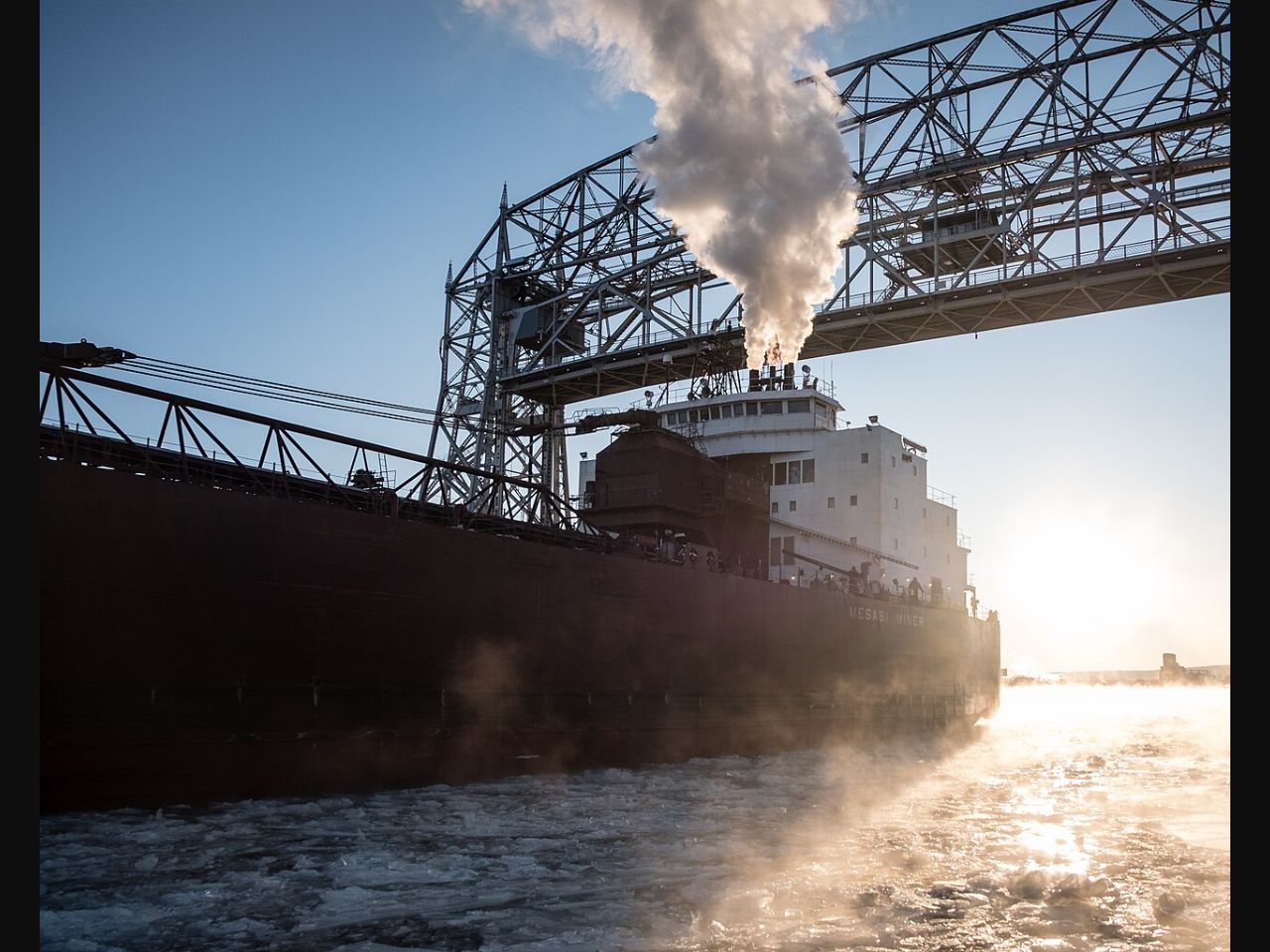
Archive image: Mesabi Miner, Duluth, Dec. 31, 2017. Sharon Mollerus · CC BY 2.0. Photographic crop for display.
The harbor above is drawn, not observed: snow, ice and dock lights follow the season dial.
01 Where the fleet sleeps
Pick a winter, then a harbor. Each glowing pin is a harbor with dated layup records; open one to see its ships drawn side by side at true scale.
Select a season to view documented harbor records.
Compare verified and reported winter records Each historic report retains its dated source. It does not show a live ship position.
Records and counts apply only to the selected winter. Map pins are approximate harbor references, not live positions or exact berths. Dock drawings use published hull lengths and an illustrative berth order. Photos are archival and may show another season.
Current season status
New arrivals appear when there is dated source evidence, not when AIS stops moving.
The harbor watch / AIS signals
Checking recent harbor traffic…
02 Documented layups
Each ship is drawn to the same scale, so a 1,000-footer and a 680-foot river-class laker look as different here as they do at the dock. Click any vessel card to open its verified photograph, berth history, and source links.
Showing vessels for the selected winter.
Redwood Group Elevator M · Superior, Wisconsin

Fraser Shipyards · Superior, Wisconsin

Ogdensburg Pier · Superior, Wisconsin

Fraser Shipyards · Superior, Wisconsin

Fraser Shipyards · Superior, Wisconsin

Fraser Shipyards · Superior, Wisconsin


Pinney Dock 4 (community-reported) · Ashtabula, Ohio


Midwest Overseas Terminal (community-reported) · Toledo, Ohio


Lafarge, Section 22 (community-reported) · Hamilton, Ontario


Keefer Terminal (community-reported) · Thunder Bay, Ontario

Marine Terminal 51 (community-reported) · Toronto, Ontario

Cargill Elevator (roster spelling: Cargil) (community-reported) · Sarnia, Ontario

Nicholson terminal (roster: Nicholsons) (community-reported) · Ecorse, Michigan

Ontario Shipyard (community-reported) · Port Weller, Ontario


Morterm Terminal (community-reported) · Windsor, Ontario

Above Lock 8 (community-reported) · Port Colborne, Ontario
A freighter's winter chapter
03 Ship history
Six vessels in the winter archive have illustrated, source-linked biographies tracing how each hull was built and where it spent documented winters.
The winter manifest / ship-by-ship evidence
Turn the pages of a working harbor ledger. Follow a documented ship, then open the evidence behind its winter stay. These records tell us what was reported, not where every ship on the lakes spent the season.
Records in this selected archive, not harbor fleet capacity.
Record as of · Great Lakes & Seaway Shipping Online (Boatnerd)
Record as of · Great Lakes & Seaway Shipping Online (Boatnerd)
Record as of · Great Lakes & Seaway Shipping Online (Boatnerd)
Record as of · Great Lakes & Seaway Shipping Online (Boatnerd)
Record as of · Great Lakes & Seaway Shipping Online (Boatnerd)
Record as of · Great Lakes & Seaway Shipping Online (Boatnerd)
Record as of · Wisconsin Marine Historical Society
Record as of · Great Lakes & Seaway Shipping Online (Boatnerd)
Record as of · Community Waterfront Heritage Centre
Record as of · Great Lakes & Seaway Shipping Online (Boatnerd)
Record as of · Great Lakes & Seaway Shipping Online (Boatnerd)
Record as of · Great Lakes & Seaway Shipping Online (Boatnerd)
Record as of · Wisconsin Marine Historical Society
Record as of · Wisconsin Marine Historical Society
Record as of · BoatNerd Discussion Forum (community reports)
Record as of · Duluth Seaway Port Authority
Record as of · Duluth Seaway Port Authority
Record as of · Duluth Seaway Port Authority
Record as of · Duluth Seaway Port Authority
Record as of · Duluth Seaway Port Authority
Record as of · Duluth Seaway Port Authority
Record as of · Great Lakes & Seaway Shipping Online (Boatnerd)
Record as of · The Maritime Executive
Record as of · Great Lakes & Seaway Shipping Online (Boatnerd)
Record as of · Great Lakes & Seaway Shipping Online (Boatnerd)
Record as of · Great Lakes & Seaway Shipping Online (Boatnerd)
Record as of · Great Lakes & Seaway Shipping Online (Boatnerd)
Records in this selected archive, not harbor fleet capacity.
Record as of · Great Lakes & Seaway Shipping Online (Boatnerd)
Record as of · Great Lakes & Seaway Shipping Online (Boatnerd)
Record as of · Great Lakes & Seaway Shipping Online (Boatnerd)
Record as of · Great Lakes & Seaway Shipping Online (Boatnerd)
Record as of · Great Lakes & Seaway Shipping Online (Boatnerd)
Record as of · Community Waterfront Heritage Centre
Record as of · Bayshore Broadcasting quoting CSL Ships director of communications
Record as of · Great Lakes & Seaway Shipping Online (Boatnerd)
Record as of · Great Lakes & Seaway Shipping Online (Boatnerd)
Record as of · Great Lakes & Seaway Shipping Online (Boatnerd)
Record as of · Great Lakes & Seaway Shipping Online (Boatnerd)
Record as of · Great Lakes & Seaway Shipping Online (Boatnerd)
Record as of · Great Lakes & Seaway Shipping Online (Boatnerd)
Record as of · Great Lakes & Seaway Shipping Online (Boatnerd)
No records in this curated archive match that harbor. Choose another harbor or show all harbors.
Across the ledgers: American Century, Alpena, Mark W. Barker, Oakglen, Algoma Equinox, Thunder Bay, Algoma Compass, Algoma Buffalo, Algoma Harvester, Whitefish Bay, Baie Comeau, Edwin H. Gott, Paul R. Tregurtha, CSL Tadoussac appears in more than one curated winter record. This does not establish continuous occupancy or an identical berth.
Reading the evidence: A curated selection of documented vessel winters, not a full fleet census. Different seasons have different source coverage; record counts are not fleet totals. Dates marked “Record as of” refer to dated source records, not necessarily actual arrival dates. These are historical reports, not live AIS positions.
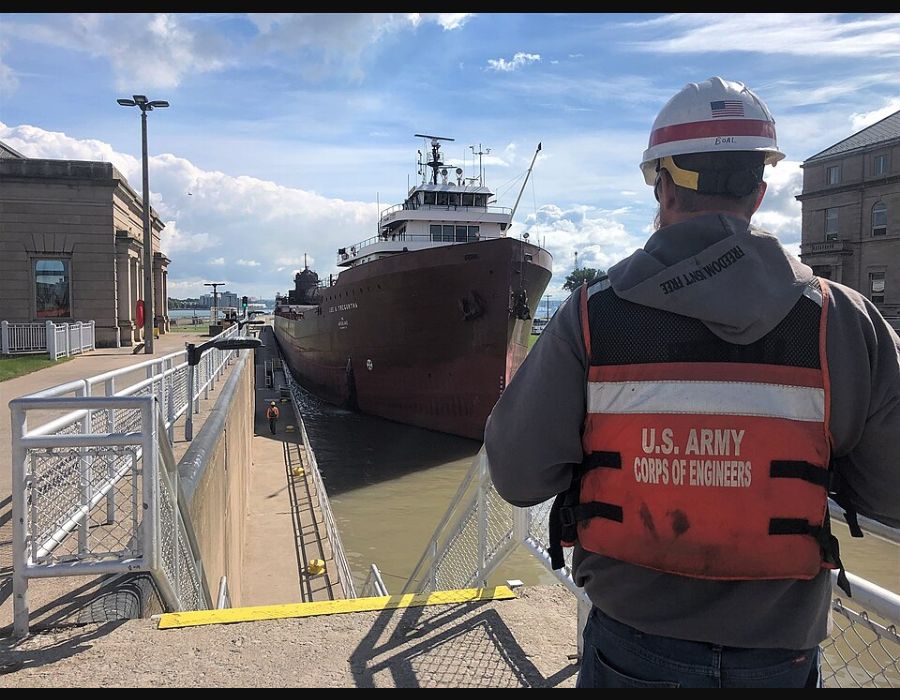 A SECOND LIFEFrom wartime tanker to lakerThe ship that crossed oceans in World War II, then returned for a winter at Fraser Shipyards.Meet the ship
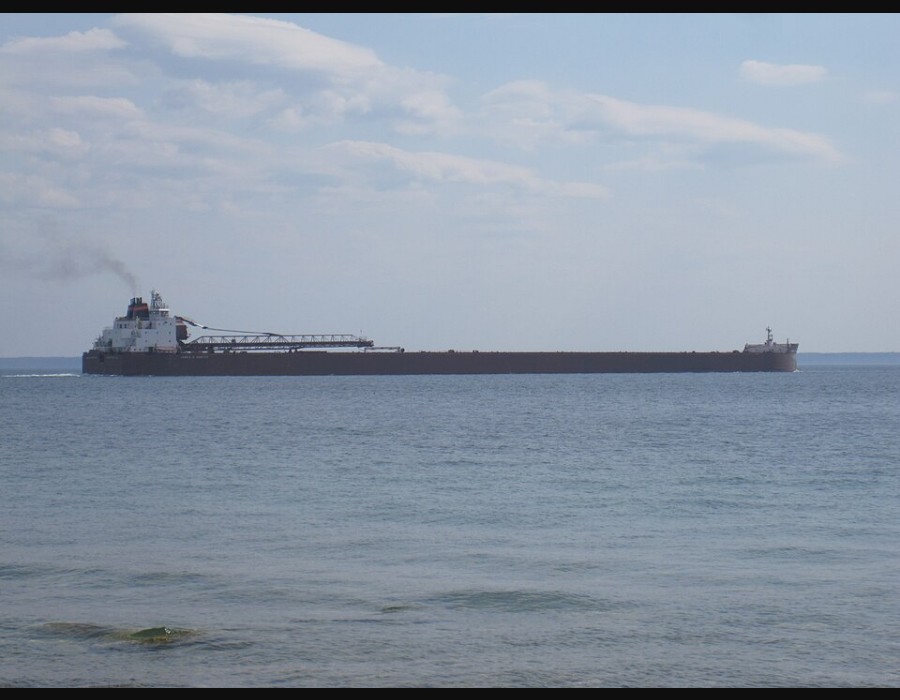 BIG SHIP HISTORYThe first built-on-the-Lakes thousand-footerA record-setting hull and a winter in Sturgeon Bay's graving dock.Meet the ship
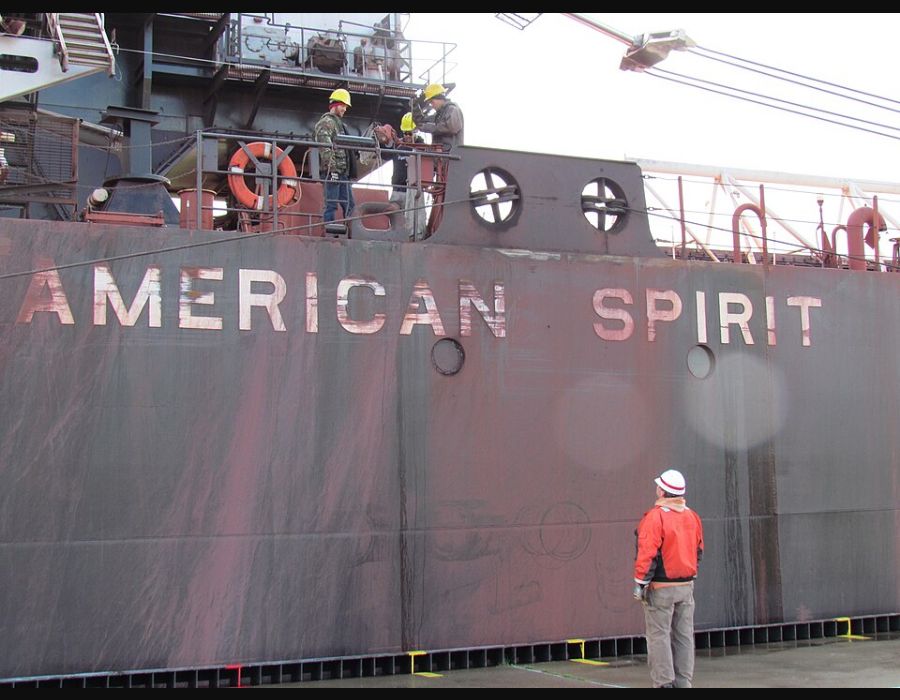 THE LAST MILESAn icebreaker and a January arrivalHow a Lake Erie ice escort became part of one freighter's winter story.Meet the ship
Lee A. Tregurtha: U.S. Army Corps of Engineers, public domain. James R. Barker: Levi Gates, CC BY-SA 4.0. American Spirit: U.S. Army Corps of Engineers Detroit District / Michelle Hill, CC BY-SA 2.0.
04 Below the winter silence
Lock schedules, ice, freight demand and maintenance all shape the winter break.
 JAN 15 – MAR 25 CLOSURE
The Welland Canal clears its last ships around the turn of the year and the Soo Locks shut on January 15 for maintenance. Nothing moves between Lake Superior and the lower lakes until March 25. Many ships that could run through ice simply have nowhere to go.
Ride the Soo Locks ↗ GRAVING DOCKS & FIT-OUT
A laker runs nine months without a break, so January through March is when hulls are inspected, engines overhauled, self-unloader belts replaced and steel renewed. The quiet harbor is the busiest time of year for the yards.
Inside winter shipyard work ↗ NOAA ICE & USCG CUTTERS
Ice cover decides how long the last trips can run and how hard the icebreakers work in March. The NOAA ice record gives the regional picture; it cannot tell you about the ice beside one dock.
04A Four-Season Maritime Calendar · All 4 Phases
The Great Lakes fleet follows a four-phase operational cycle governed by the St. Lawrence Seaway and the U.S. Army Corps of Engineers at Sault Ste. Marie. All four seasonal playbooks are shown below side-by-side, with the current phase in Eastern Time (America/Detroit) automatically highlighted.
From November through January 15, thousand-footers sprint to build winter iron ore stockpiles at lower-lake steel mills while ocean-going salties clear the St. Lawrence Seaway before late December. The Welland Canal clears around January 10, and the last freighter clears the Poe Lock at Sault Ste. Marie before midnight on January 15.
With the Soo Locks closed and dewatered by the U.S. Army Corps of Engineers, Lake Superior is sealed off from the lower lakes. Nearly the entire U.S. and Canadian laker fleet sits moored in winter berths at Superior/Duluth, Sturgeon Bay, Toledo, Milwaukee, Sarnia, Owen Sound, Port Colborne, and Hamilton for five-year hull inspections, engine overhauls, and steel renewal.
In early March, crews return to the cold hulls for fit-out: lighting boilers, warming main diesels, testing unloading booms, and stocking galleys. U.S. and Canadian Coast Guard icebreakers carve tracks through Whitefish Bay, the St. Marys River, the Straits of Mackinac, and Green Bay so the fleet can race toward Sault Ste. Marie when the Poe Lock opens at 00:01 on March 25.
From mid-spring through October, the thousand-footers run 24 hours a day between Lake Superior iron-ore ports (Two Harbors, Duluth, Superior, Silver Bay, Marquette) and lower-lake steel mills and power plants. While the fleet is underway, this page serves as a permanent historical archive and biography library for the ships you spot passing shore.
04B Illustrated Port & Shipyard Field Guide
Shipyards and commercial cargo docks are private industrial facilities, never public driving destinations. However, several of the Great Lakes' most famous winter layup harbors sit directly across from public parks, bridges, and waterfront boardwalks where you can photograph laid-up thousand-footers safely from shore. Open the full 12-stop Great Lakes Winter Freighter & Harbor Field Guide ↗
Lake Superior · Twin Ports
6 Archive Ships (2025–26)
Fraser Shipyards · Ogdensburg Pier · Redwood Group Elevator M
The premier winter layup and heavy-repair hub for the thousand-foot iron ore fleet. Fraser Shipyards operates two graving docks in Superior where hulls like Lee A. Tregurtha, Mesabi Miner, Hon. James L. Oberstar, and John J. Boland undergo major winter overhauls.
Photo: Tony Webster · CC BY-SA 2.0 (archival).
Lake Michigan · Door County
3 Archive Ships (2025–26)
Fincantieri Bay Shipbuilding · 1,158-ft Graving Dock
Door County's working shipyard town hosts one of the largest winter concentrations of classic lakers and 1,000-footers on the Great Lakes, including 2025–26 winter stays by James R. Barker, Edgar B. Speer, and Manitoulin.
Photo: SigmaJosh · CC BY-SA 4.0 (archival).
 Lake Erie · Maumee River
1 Archive Report (2025–26)
Port of Toledo · Ironhead Marine · Maumee River Berths
Western Lake Erie's industrial port receives late-January arrivals often escorted through heavy Pelee Passage ice by U.S. Coast Guard cutters, such as American Spirit's January 2026 arrival behind USCGC Neah Bay.
Photo: Wolfgang Fricke · CC BY 3.0 (archival).
 Lake Michigan · Inner Basin
1 Archive Ship (2025–26)
Jones Island · Municipal Mooring Basin (South Kinnickinnic)
Milwaukee's sheltered inner harbor basin has hosted iconic thousand-footers for winter layup, including the first 1,000-footer on the Great Lakes, Stewart J. Cort, documented arriving January 20, 2026.
Photo: Dori · CC BY-SA 3.0 US (archival).
Georgian Bay · Ontario
2 Archive Ships (2024–26)
Owen Sound Inner Harbour · East & West Harbour Walls
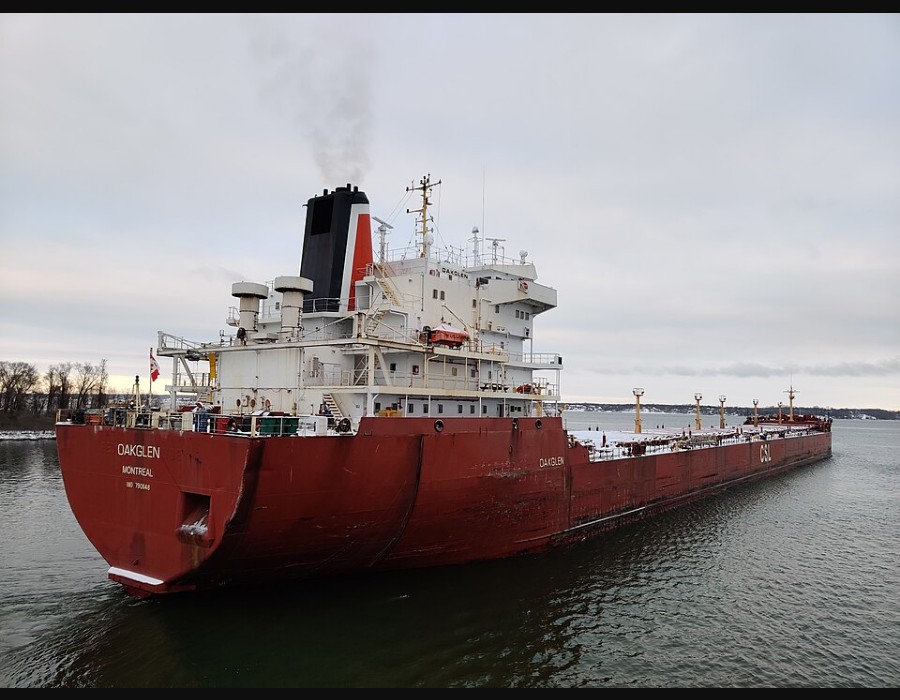
A classic Canadian winter layup port on southern Georgian Bay. Documented across both our 2024–25 and 2025–26 archives with Algoma Compass (assisted by icebreaker CCGS Judy LaMarsh) and CSL's Oakglen.
Photo: JustSomePics · CC BY-SA 4.0 (archival).
 Lake Huron · St. Clair River
Monitored Watch Harbor
Sarnia North Slip · Government Dock · Blue Water Bridge
Located at the foot of Lake Huron, Sarnia Harbour is a primary Canadian winter berthage port for self-unloaders and bulk carriers, visible across the fast-flowing St. Clair River from Port Huron, Michigan.
Photo: USACE Detroit District · CC BY-SA 2.0 (archival).
 St. Marys River · Sault Ste. Marie
Closed Jan 15 – Mar 25
Poe Lock & MacArthur Lock · USCG Sector Sault Ste. Marie
Why the upper-lakes fleet lays up: every January 15, the U.S. Army Corps of Engineers closes the Soo Locks, pumps millions of gallons of water out of the chambers, and lowers heavy equipment onto the lock floor until March 25.
Photo: USACE Detroit District · Public domain (archival).
 Lake Erie & Lake Ontario · Seaway
Monitored Watch Harbors
Welland Canal Tie-Up Walls · HOPA Ports Hamilton Harbour
At the eastern end of Lake Erie and western end of Lake Ontario, Canadian self-unloaders and gearless bulkers tie up along the Welland Canal walls in Port Colborne and at HOPA Ports piers in Hamilton Harbour.
Photo: GuavaTrain · CC BY-SA 4.0 (archival).
04C Winter Shipping Reference
When the Welland Canal closes around late December / January 10 and the Soo Locks close on January 15, Great Lakes freighters tie up in protected winter layup harbors across the United States and Canada. Major winter layup and shipyard ports include Superior/Duluth (Fraser Shipyards, Ogdensburg Pier, and Elevator M), Sturgeon Bay, Wisconsin (Fincantieri Bay Shipbuilding), Toledo, Ohio (Maumee River and CSX/Midwest docks), Milwaukee, Wisconsin (Jones Island and the Municipal Mooring Basin), Sarnia, Ontario, Owen Sound, Ontario, Port Colborne, and Hamilton, Ontario.
Under federal regulation and the U.S. Army Corps of Engineers schedule, the Soo Locks in Sault Ste. Marie, Michigan close annually on January 15 and reopen on March 25. During that ten-week shutdown, the Poe Lock is pumped dry (dewatered) so crews can inspect and repair miter gates, Filling/Emptying valves, and chamber walls that operate nonstop for nine months of the year.
While shipyards and cargo docks are strictly private industrial property, several harbors offer close public vantage points: in Sturgeon Bay, WI, the Michigan Street Bridge, Oregon Street Bridge, and Sawyer Park look directly toward Fincantieri Bay Shipbuilding; in Superior/Duluth, Barker's Island and Canal Park offer views of winter docks and March departures; in Owen Sound, ON, public paths line the inner harbour walls; and in Toledo, OH, Glass City Metropark and the National Museum of the Great Lakes overlook the Maumee River.
Freighters routinely anchor for winter gales, wait for unloading docks, shift berths inside a port, or power down AIS transponders after mooring. Inferring winter layup from AIS speed alone produces false reports. This atlas separates live AIS harbor traffic from the winter layup roster and only records a winter berth when a dated source report from a port authority, maritime historical society, museum, operator, or corroborated harbor observer confirms it.
The source network: U.S. and Canada
Source reports and regional discovery leads are checked for documented winter milestones.
Official berth status: Canadian primary source
View HOPA's live Hamilton vessel-status board ↗
HOPA distinguishes layup/repairs from ordinary cargo visits. Its status board is an external reference, not yet an automatically ingested vessel record. Its entries must not be presented as our confirmed layups without verification.
What these records mean